
Demonstrative Impunity

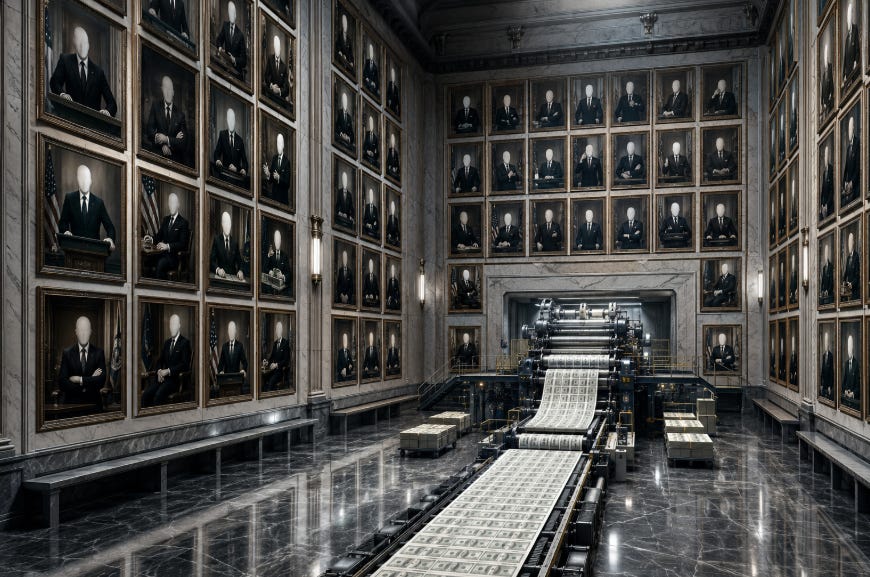
There is a proposed bill sitting in Congress right now. On it, the face of a living president. Not a founding father. Not a fallen hero. A living, sitting, polling-underwater occupant of the White House who has already put his signature on every newly printed dollar, renamed federal buildings after himself, hung his face above the entrance to the Justice Department, and renovated the people’s house to look like a Vegas ballroom with diplomatic pretensions.
Each of these things happened in public. Each of them was reported. Each of them got a news cycle, a few outraged posts, and some expert commentary about norms and precedent. And then the next thing happened. And the next. And the next.
This is not sloppiness. This is not arrogance in the conventional sense. This is a message being sent, clearly and repeatedly, to anyone paying attention.
The message is: I am not afraid of you.
Authoritarian consolidation has a well-documented playbook, but it has always depended on some degree of concealment. The corrupt leader who skims from the treasury does it through shell companies and intermediaries. The strongman who rewrites institutional rules does it through procedural complexity, burying the mechanism in legislation nobody reads. The instinct has always been to obscure, to maintain plausible deniability, to keep the operation below the threshold of undeniable visibility.
What we are watching now dispenses with all of that.
The orange stain doesn’t hide. He inscribes. His name on the buildings. His signature on the money. His face above the institution whose entire purpose is to be indifferent to any individual. His image proposed for the currency, with a Treasury director reassigned for having the audacity to resist. Children born in America between 2025 and 2028 will carry savings accounts that bear his name into adulthood. The physical and financial architecture of the state is being marked, surface by surface, the way a sovereign marks a kingdom.
And he is doing all of this while seriously underwater in the polls.
That detail is not incidental. It is the entire point.
A conventional politician underwater in the polls moderates. Retreats. Finds safer ground. Triangulates toward the median voter. Every political consultant in Washington will tell you this is the rational response to declining numbers. You protect your base, you reach toward the centre, you avoid the kind of visible overreach that hands your opponents a weapon.
The orange buffoon is accelerating.
Not retreating. Not moderating. Accelerating. More monuments. More inscriptions. More surfaces marked. More institutions were renamed, repurposed, and redecorated to reflect not the republic but the man.
This behaviour only makes sense if you understand what it is actually communicating.
Demonstrative impunity is not about the act itself. The $250 bill is not really about the $250 bill. The ballroom is not really about interior design. The Arc proposed for Washington is not really about commemorating military glory, though the Napoleonic echo is instructive. Each act is a demonstration. Each act says, “Watch me do this. Watch me do this in full public view. Watch the opposition sputter. Watch the press cycle through outrage and move on. Watch the polls register disapproval that translates into nothing.”
Every time the act is visible, and the consequence doesn’t arrive, the power is not merely maintained. It is reinforced. The lesson lands on everyone watching, including those who might otherwise resist: this is how it is now. This is the landscape. Adjust accordingly.
This is what authoritarianism looks like when it has matured beyond the need to hide. The instinct isn’t the aberration. It’s the arrival.
The press is not equipped for this. Journalism is organised around events. A thing happens, you cover the thing. A statement is made, and you fact-check the statement. What nobody has the institutional architecture to cover is a pattern, because a pattern requires you to stand back far enough to see the whole shape. And standing back that far, in the current media environment, looks like opinion. Looks like bias. Looks like exactly the kind of thing that gets you accused of derangement.
So each piece of the mosaic gets its own news cycle. Nobody assembles the mosaic and holds it up to the light.
The opposition has a related but different problem. The moment you say this plainly, you hand the other side a ridicule weapon. You sound extreme. You sound like someone who has lost perspective. The safest move is to stay on policy. Talk about healthcare. Talk about tax rates. Talk about the specific legislative content of the One Big Beautiful Bill. Stay in the terrain where the argument is legible and documentable and doesn’t require your audience to accept a conclusion that frightens them.
Meanwhile, the architecture gets built.
There is a phrase that surfaces in studies of democratic erosion: the opposition always fights the last war. They build their strategy around the accountability mechanisms that worked before, assuming those mechanisms still function. Courts. Elections. Public opinion. The pressure of unfavourable polling. They wait for the correction that the system is supposed to deliver.
But systems deliver corrections only when the people inside them believe the corrections are coming.
Behaviour is the most honest data we have. And the behaviour on display, day after day, monument after monument, inscription after inscription, is the behaviour of someone who has looked at the accountability infrastructure and made an assessment.
Not a public assessment. Not a declared one. An operational one, visible only in what keeps happening.
He is not afraid of the polls. He is not afraid of the courts. He is not afraid of the historians, the press, the opposition, or the judgment of whatever comes next. He is building as if there is no reckoning on the horizon. As if the horizon itself has been dealt with.
The open corruption, the visible impunity, the relentless inscription of one man’s image onto the machinery of the state, these are not the acts of someone who expects to be held accountable.
Which leaves the question that the opposition has not yet found the courage to ask out loud.
What does he know that they don’t?
The background to this story, sixteen years in the making, twelve countries in scope, one mechanism at its core, is in the book.
Kleptocracy is available for pre-order now at $7.99 until 1 June 2026, after which the price moves to $14.99.
https://www.amazon.com/KLEPTOCRACY-They-What-Take-Stop-ebook/dp/B0GYKQ3ZC7
Aldo Grech is the author of Silent Echoes, The Great Populism Hustle, and HOW: Elections Are Won in the Digital Age. He writes on political manipulation, narrative capture, and the mechanics of power.
”The future is embedded in the choice”. Books and private advisory.